The Tata Trusts’ enduring commitment to creating and supporting high-quality institutions is finding newer forms of expression

COVER STORY
Women show the way
In Patan, a city in Gujarat that is among the hottest in India, women's groups are banding together to battle heat stress
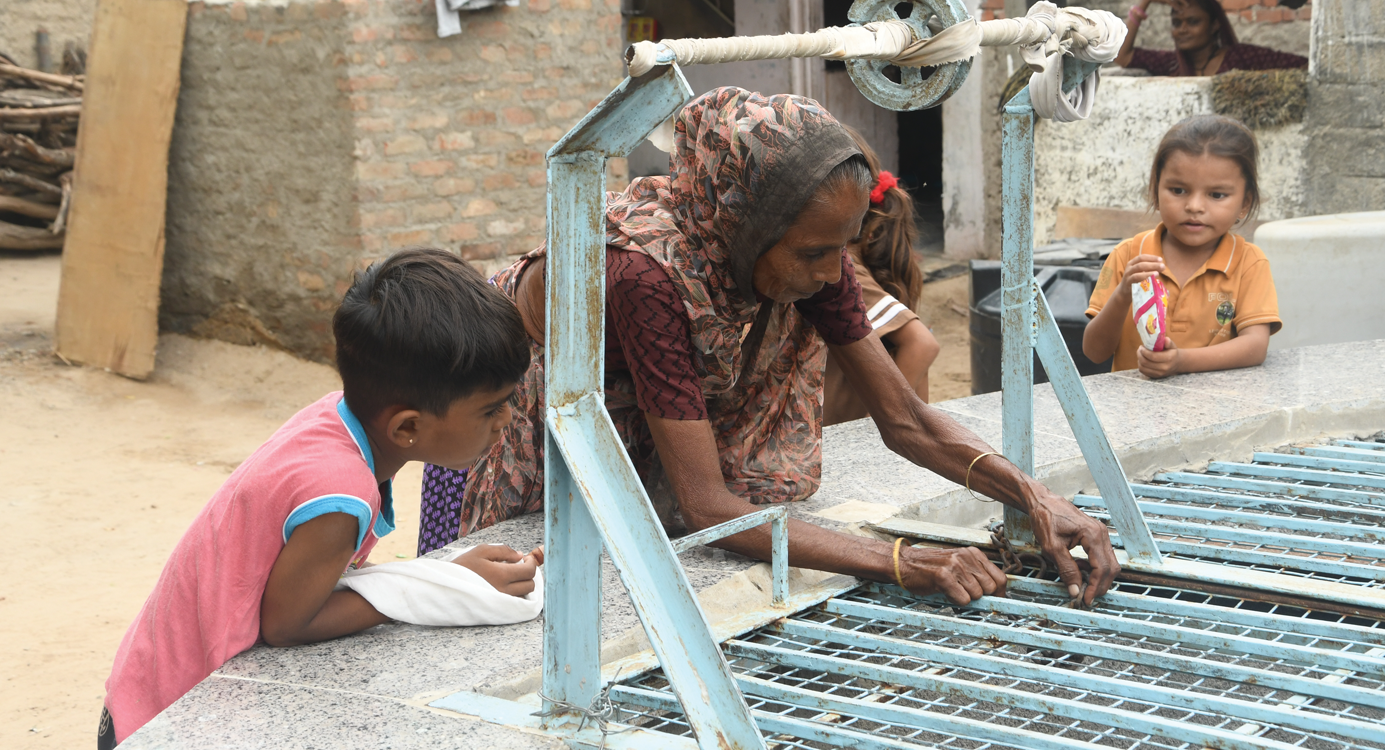
Taraben Thakur remembers a time when the 80-year-old well in her settlement of Shramjivi in Gujarat’s Patan district had so much water you could reach over and touch it. “All we had to do was scoop some out when we needed it,” says the 60-year-old, who came to Shramjivi at 10 and has lived there ever since. “Now we have to walk several kilometres every day to fetch water even though the well is just two steps away from our homes.”
Over a few decades, as its water level depleted, the well that Ms Thakur and others depended on turned into a giant garbage vat. Last year, following a plan to rejuvenate it, some 50 truckloads of trash were removed from the well and the stone lining was reinforced. “A hydrologist told us that it will take a few monsoons to recharge,” adds Ms Thakur.
When it does, the well will not only serve the 40-50 homes built concentrically around it, but an entire neighbourhood that has been facing acute water shortage for years. The households close by have even adopted rooftop rainwater harvesting to further strengthen the water recharge in the well, and other measures for water retention are being explored.
[The well was rejuvenated by removing accumulated waste and addressing structural issues. Following a technical and structural safety assessment, its stone lining was reinforced and rejuvenation work was completed. Water is now reaching the well, although the thick sand layer is limiting water retention. It is expected to take 2–3 monsoon seasons for the water level to rise and stabilise.]
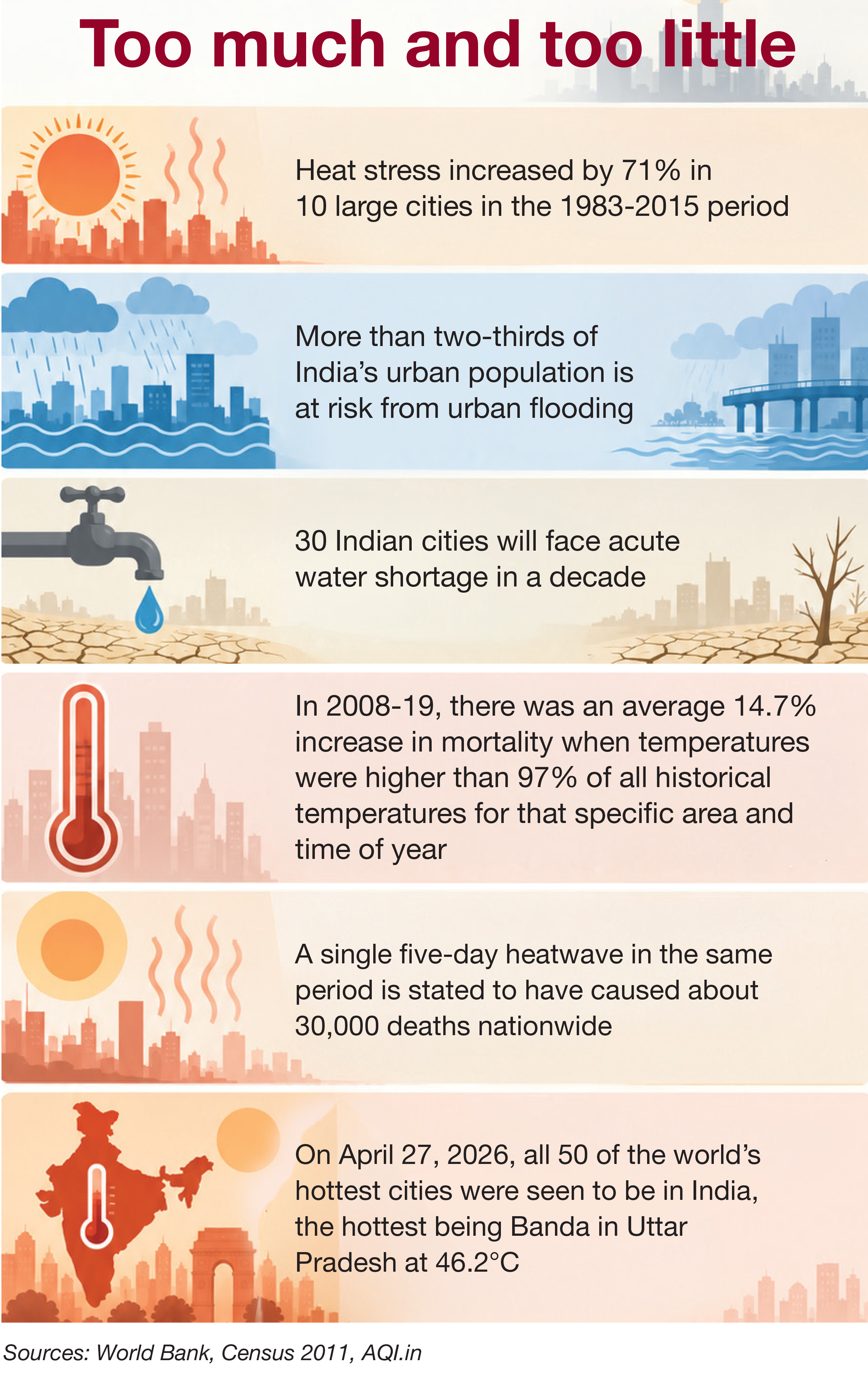
Shramjivi is one of 74 low-income urban settlements in Patan — a few hours’ drive from Ahmedabad — that are suffering from heat stress and related challenges such as water scarcity, air pollution and a disruption in lives and livelihoods. Patan, surrounded by industrial towns like Mehsana, Deesa, Palanpur and Sidhpur, often ranks among the hottest cities in India, with daytime temperatures sometimes touching 45°C.
[According to a World Bank study, 19 districts in Gujarat could become climate change hotspots by 2050, with temperatures expected to rise by 2-2.5°C. That may explain why the Gujarat government has set up a Department of Climate Change and adopted a state-wide climate action plan.]
Something needed to be done, and urgently. In 2024, the Tata Trusts joined hands with the Ahmedabad-based Gujarat Mahila Housing Trust (GMHT) to launch the ‘climate-smart Patan’ initiative, an attempt to offset the effects of heat stress in 10 settlements in the city.
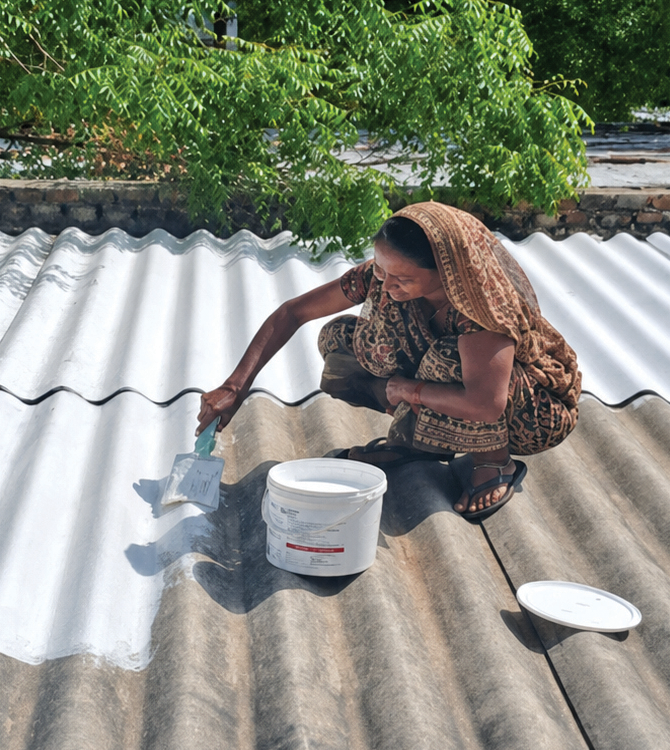
A resident of Bhattiwada in Patan applies white solar reflective index paint to the roof of her house to cool it
“Our programme strategy is two-fold: addressing climate resilience at both the slum and the city levels in Patan,” says Sujata Menon, program officer, urban poverty alleviation, with the Trusts. “At the slum level, we aim to empower women leaders from the settlements that we work in, equipping them with the capacity to lead climate change interventions within their communities. At the city level, we facilitate the development and execution of climate action plans.”
This dual approach ensures that the programme not only fortifies vulnerable slum communities against the potentially devastating effects of climate change but also contributes to overall heat stress reduction.
Click to enlarge
Taraben Thakur of the Shramjivi settlement in Patan checks the 80-year-old well in her neighbourhood that is being rejuvenated to provide an additional source of water
In Patan, the Trusts and GMHT work primarily with women from slum communities, facilitating their mobilisation into mahila mandals (women’s community action groups) and nurturing them as change agents by providing the necessary tools and knowledge.
“Gender-responsive interventions are critical to help women in urban slums better cope with the impacts of climate change,” explains Ms Menon. “By fostering women’s leadership, we want to create a more equitable and inclusive climate resilience strategy, ultimately benefiting women as well as the broader community.”
The initiative began with a baseline study of about 1,500 households. “We visited the settlements to assess their challenges and then encouraged the women to map the entire slum, identifying problem areas and possible solutions,” says Bharati Bhosale, senior program manager, GMHT.
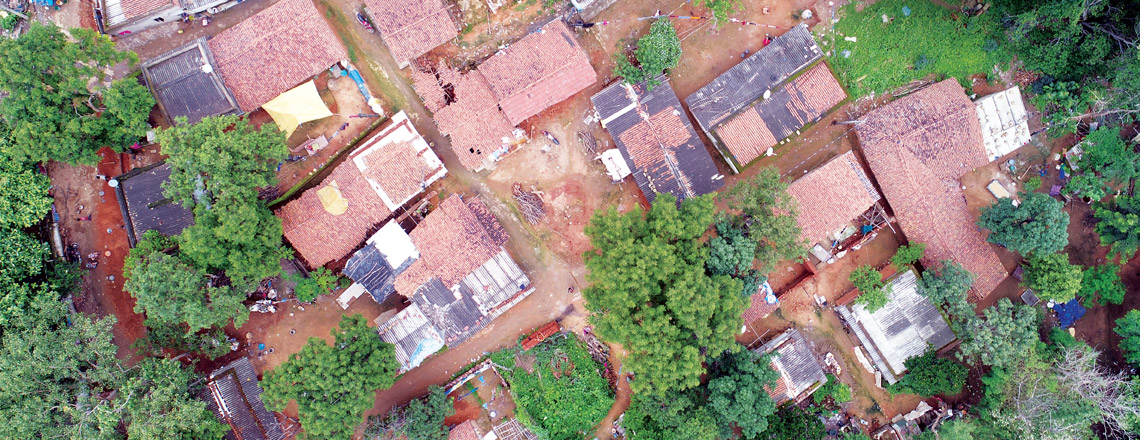
Homes ahoy
Drones are the unlikely allies in a programme that employs eye-in-the-sky technology to help provide land rights to 1 million slum dwellers in Odisha’s urban centres
READ MOREData collected from various state and civic bodies were used to create a slum development plan (SDP) that would form the basis for the Trusts-GMHT programme.
The SDP clearly defines what the community wants to achieve, the activities required during a specified time period, and the resources needed for these to be successful. Women leaders, trained and equipped for the purpose, lead the work charted out in the SDPs, which attempt to address vulnerabilities at the individual, household and settlement levels.
A similar city climate action plan has been adopted for urban Patan, and this includes data related to emissions from three primary sources: stationary, solid waste and transport.
The urban settlements were lacking basic amenities such as water, sanitation, waste management and paved roads. Many homes did not have toilets and open defecation was common.
“Having lived through and accepted this as their lot for years, the residents did not even know they could ask for improvements,” adds Ms Bhosale. “We began by sensitising them through meetings, video shows and documentation to create awareness about the effects of climate change. Then we formed the action groups.”
Click to enlarge
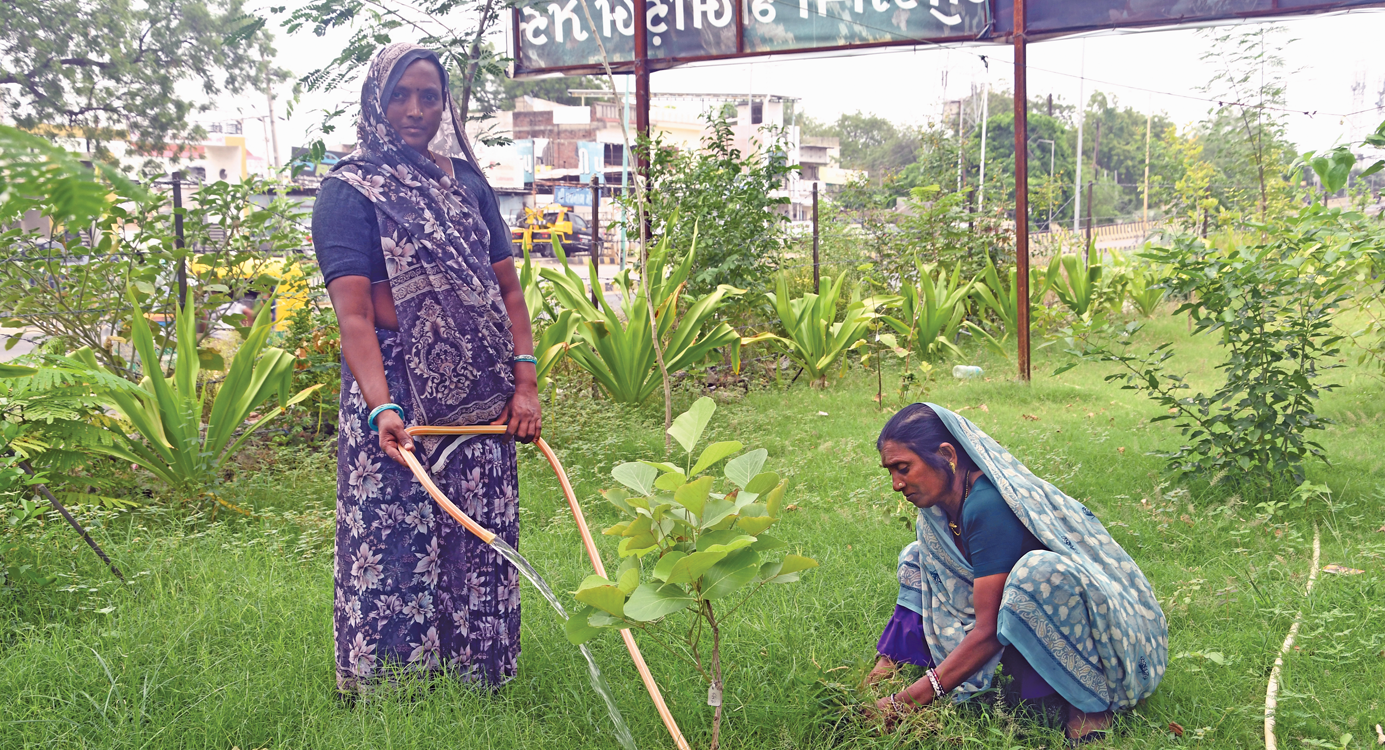
Residents of the Ramnagar II settlement in Patan tend to their Oxygen Park
The women got going by coming together to collectively demand solutions, with guidance from GMHT about whom to approach in civic bodies and how.
Soniben Parmar has certainly benefitted from such guidance. When Ms Parmar got married 17 years ago and came to live in Tayarnagar, a settlement in Patan, it was like an abandoned community. “People were leaving because there were no jobs, no roads or civic amenities,” she says. “The drains were overflowing and every tree in the area had been cut down because people thought, mistakenly, that their roots were clogging the drains. A little rain and our entire area would get flooded.”
Some years ago, after Ms Parmar had to wade through filthy waist-deep water to a nearby hospital for the birth of her second child, she decided enough was enough. Ms Parmar began gathering women from the 117 households in Tayarnagar to form a committee and petition the local civic body.
After many, many applications and personal appeals to officers, Ms Parmar and her sisterhood now have a paved road, better sanitation and large vats for garbage collection all over the settlement. Adds Ms Parmar’s sister-in-law, Kavita: “It wasn’t just everyday challenges. The lack of amenities was affecting our livelihoods.”
Some 60 women in the settlement, including the Parmars, are engaged in embroidery work that they do from home. The flooding and dirty conditions of the settlement used to deter buyers and contractors.
“During the monsoons we had no work, and contractors would routinely slash our commission, claiming they had to pay to have the garments cleaned once we were done,” says Ms Kavita. “That was partly true. We’ve all experienced instances when floodwater has come into our homes and ruined the stored garments.” That doesn’t happen anymore.
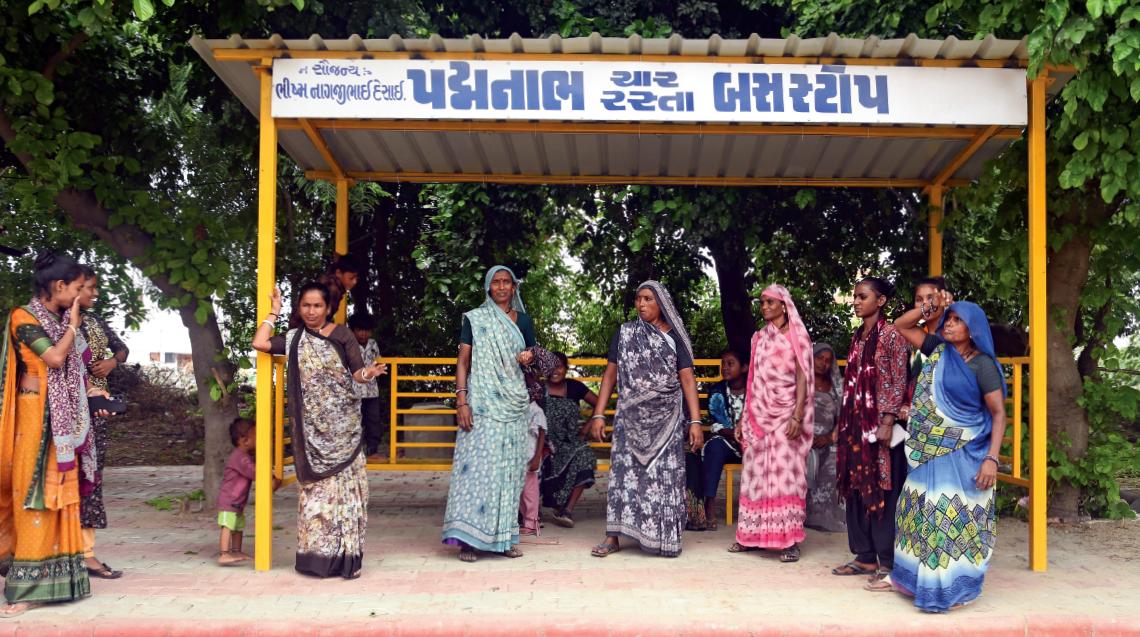
In the settlement of Ramnagar II, women have come together to create ‘Oxygen Park’, a green patch that they hope will help offset the harmful effects of air pollution. Apart from being ringed by industrial hubs, Patan also sees a considerable amount of tourist vehicular traffic because of Rani ki Vav, an 11th-century stepwell that is a UNESCO World Heritage site.
Oxygen Park, reclaimed from a garbage dump, is expected to reduce the urban heat island effect in Ramnagar II and combat air pollution. Working to ensure that are Zeniben Thakur, Jyotsnaben Thakur and Jhumaben Thakur, who tend to the park every afternoon once they are done with their farming duties.
“We have received extensive training in urban forestry,” says 60-year-old Ms Zeniben, “enough to handle everything from weeding, watering and protecting new saplings and trees, to requesting new plants from civic authorities. When the park opens in a few months, the people of Ramnagar II — and all of Patan — will have a place to enjoy some shade and cool.”
The three Thakur women, who hail from the same family, have carried their can-do zeal back home too. A few months ago, they finally got streetlights in their settlement after petitioning the local authorities for two years.
While awareness and mobilisation are important, the programme also tackles heat reduction with effective solutions. The first is the use of white paint with a high solar reflective index (SRI) on the roofs to cool houses.
In most settlements under the programme, dwellings are small, sometimes windowless, and generally poorly ventilated. The tin sheets on the roofs created oppressive heat inside and the women, who earn their living from various home-based trades, could not stay in their homes for most of the day.
The solar reflective white paint, which has to be applied in multiple coats on the tin sheet, reduces internal temperatures by about 4-5 degrees. “In Bhattiwada we even got the roof of the local anganwadi (childcare centre) painted with solar reflective paint, and now more children are coming there,” says Ms Bhosale. “In the Gitanjali settlement, vegetable vendors can now store their surplus at home.”
GMHT has worked closely with the forest department to set up ‘cooling stations’, sitting areas in various parts of the city that are made comfortable by a constant circulation of water by way of overhead sprinklers. This is primarily for the urban poor engaged in work that keeps them outdoors in soaring temperatures.
Today in Patan, some roles have been reversed. Municipal bodies are now approaching women’s groups to replicate some of their more successful projects. Civic officials want the women of Ramnagar II to create another Oxygen Park in their area, and have decided to use the solar reflective paint on public buildings.
“Now that we have strengthened the women and the communities, they can resolve, on their own, any issues that may come up,” adds Ms Menon.
Related articles
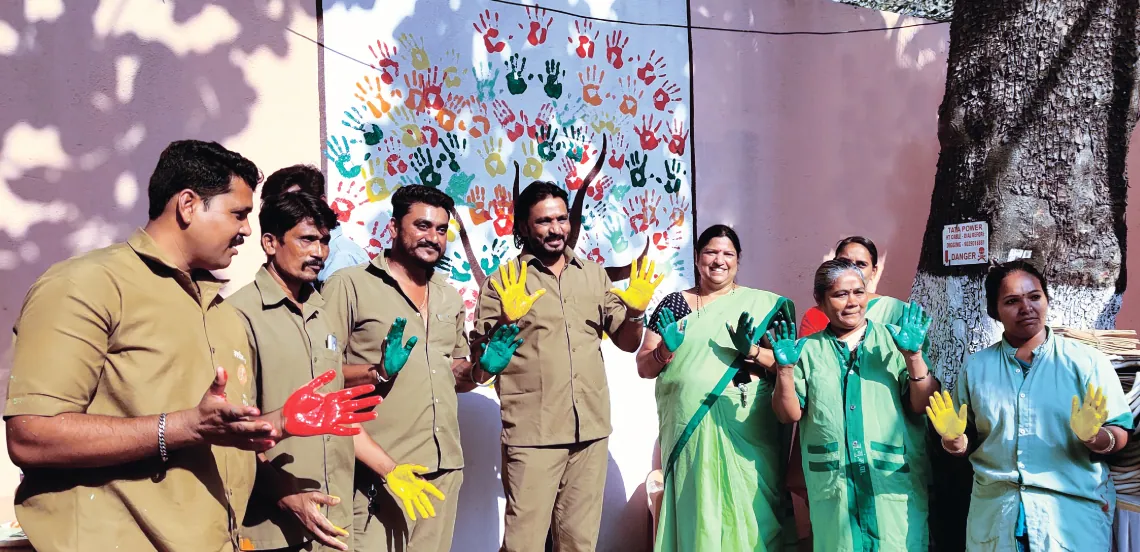
The well-being of Mumbai’s sanitation employees — an invisible workforce the city turns a blind eye to — is at the heart of Mission Garima

Mission Gaurav was a blessing for 1.37 million migrant families during the pandemic, but its true impact goes beyond the numbers and the immediate need

Bringing the children of migrant workers in Maharashtra's sugar belt back from the cold and into the formal education system has fetched encouraging results